If your home was built in Ontario in the last twenty years, or has been renovated to a decent standard of airtightness, there is a good chance there is an HRV in the basement. There is an equally good chance nobody explained what to do with it. The unit gets installed, a dial gets left wherever the installer had it, and it sits there for years either barely running or running far more than the house needs.
This is the practical version: what the thing does, which setting actually matters, what to move it to as the weather changes, and how to tell from your own windows whether you have it right.
What an HRV actually does
A heat recovery ventilator is a controlled air swap. It pulls stale, moist air out of the house and brings the same volume of fresh outdoor air in, and it passes the two streams through a core so the outgoing air gives most of its heat to the incoming air. You get fresh air without simply throwing your heating out of a window.
That matters because a modern airtight house does not breathe on its own. Older houses leaked enough through the envelope that stale air and moisture found their own way out. Tighten the envelope and that stops, so moisture from showers, cooking, laundry and simply breathing accumulates. An HRV is the deliberate replacement for the accidental ventilation the house used to have.
An HRV moves heat but not much moisture, which is what makes it the usual choice for Ontario. If you are still deciding between an HRV and an ERV rather than trying to run one you already own, we cover that comparison separately.
The only setting most people need to touch
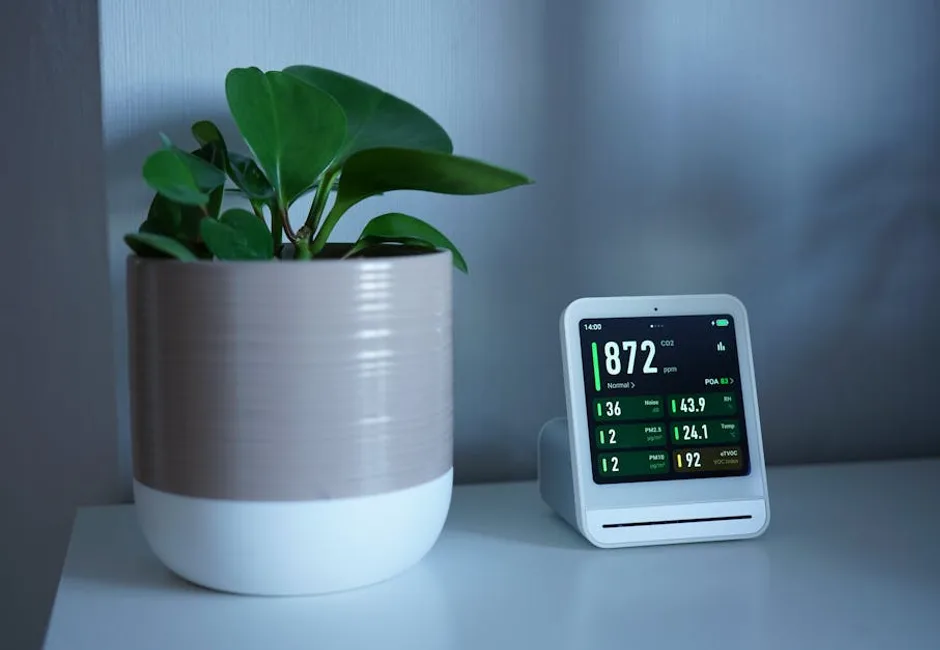
On the majority of residential HRVs the main dial is a dehumidistat. It is not a thermostat and it is not a fan speed. You are setting a ceiling for indoor relative humidity, and the unit runs when the house goes above it.
That single fact explains most complaints. A dial left at 60 percent will almost never trigger in a dry Ontario winter, so the homeowner concludes the HRV is broken when it is simply never being asked to work. A dial left at 20 percent runs the unit nearly continuously, over-ventilates, and produces the cracked-lips, static-shock house that people blame on the furnace.
What to set it to, by outdoor temperature
| Outdoor temperature | Humidity target | What you should see |
|---|---|---|
| Around 0C | 40 percent | Clear glass, comfortable air |
| Around -10C | 35 percent | Maybe light fog at the very bottom of the pane |
| Around -20C | 30 percent | Glass edges may mist briefly in the morning |
| Below -25C | 25 percent or lower | Air feels dry, but glass stays clear |
Treat that as a starting point rather than a rule. Houses differ enormously in window quality, and a home with newer triple glazing tolerates noticeably more humidity than one with older double-pane units, because the inside surface of the glass simply does not get as cold.
Why the number has to move with the weather
Condensation is not about how humid the air is in the abstract. It is about the coldest surface the air touches, and in winter that surface is your window glass. Warm indoor air meets glass chilled from outside, the air right at the glass cools, and once it cools past its dew point the moisture it was carrying has nowhere to go but onto the pane.
Drop the outdoor temperature and you drop the glass temperature with it, which lowers the humidity the room can carry before that happens. This is why a setting that was perfectly comfortable in November starts fogging windows in January. Nothing failed. The weather moved and the setting did not.
Left alone long enough, that condensation stops being cosmetic. Water sitting on sills and frames leads to staining, then to mould at the frame, then to damage to the frame itself. Adjusting a dial twice a winter is a great deal cheaper than replacing window trim.
Fan speed: low and constant beats high and occasional
Most units offer a continuous low speed plus a boost. For everyday running, continuous low is the better choice. It gives a steady air change rather than swings, recovers heat more effectively because the core stays at a stable temperature, and it is quiet enough to ignore.
Use the boost for the moments you are genuinely adding moisture faster than the house can shed it:
- Showers and baths, ideally for twenty to thirty minutes afterwards rather than only during
- Cooking, especially anything boiling or steaming for a long stretch
- Drying laundry indoors, which puts a surprising amount of water into the air
- A full house of guests, since people are a continuous moisture source
- After any indoor painting or finishing work
Reading the signs your settings are wrong
You do not need instruments to diagnose this. The house tells you.
Set too high, meaning not ventilating enough: condensation on windows, a musty or stuffy smell that returns after airing out, bathroom mirrors staying fogged a long time, and in bad cases mould appearing at window frames or in closet corners on outside walls.
Set too low, meaning over-ventilating: static shocks, dry throats and noses, lips cracking, wood floors and trim developing gaps, houseplants struggling, and a heating bill higher than it should be because you are exhausting more heated air than the house needs to lose.
Frost, defrost and deep cold
In genuine cold an HRV will frost up at the core, because you are passing warm moist outgoing air across a surface chilled by incoming air well below freezing. Every unit sold for this climate has a defrost strategy for exactly that, usually pausing the intake or recirculating for a few minutes on a cycle, then carrying on.
So a unit that periodically stops and starts in a cold snap is behaving correctly, and it is one of the most common things people call in as a fault. What genuinely warrants a look is a core frozen solid rather than lightly frosted, water pooling under the unit, an intake or exhaust hood buried in drifted snow, or a unit that stops and never resumes.
The maintenance that keeps the settings meaningful
Settings only work if air is actually moving. A dial set perfectly on a unit with clogged filters is ventilating far less than you think.
- Rinse or vacuum the filters every two to three months through the heating season
- Clean the core once a year, following your manual on whether it may be washed
- Keep the outdoor intake and exhaust hoods clear of snow, ice and drifting, which matters most on exposed lots
- Check that the condensate drain is flowing and not frozen
- Confirm the balance between the intake and exhaust streams every few years, since an unbalanced HRV pressurises or depressurises the house
When it is the settings and when it is the unit
Almost everything above is free and takes a minute at a dial. It is worth working through it before assuming the equipment has failed, because in our experience most HRV complaints in Ontario homes are configuration and maintenance rather than a broken machine.
Call someone when the core stays frozen through a defrost cycle, when the unit will not run at all, when you cannot get on top of condensation even at a low setting, when the airflow at the registers is clearly weaker than it used to be with clean filters, or when the house has an unbalanced feel with doors pulling or whistling. Those point at the unit, the ductwork or the balance rather than the number on the dial.
We service and balance HRV and ERV systems across the GTA. The diagnostic is a flat $129 at any hour and it is waived if you go ahead with the work.
Book an HRV Service Call?Frequently Asked Questions
What should my HRV be set to in winter?
What does the dial on my HRV actually control?
Why do I have to change the setting as it gets colder?
Should the HRV run continuously or only sometimes?
Ice or frost is building up in my HRV. Is that a fault?
My house is too dry all winter. Should I turn the HRV off?
Do I still need to do anything to it besides the settings?
EcoFrost Heating & Cooling
Toronto's Trusted HVAC Experts Since 2015
Our certified HVAC technicians have served 5,000+ Toronto-area homes. We write about heating, cooling, and air quality from real field experience not marketing copy. Learn about us →